
Escolha de princípios e irreversibilidade do tempo em J.-J. Rousseau
DOI:
https://doi.org/10.35920/arf.v24i1-2.54453Palavras-chave:
Rousseau, filosofia, história, interpretação, tempo.Resumo
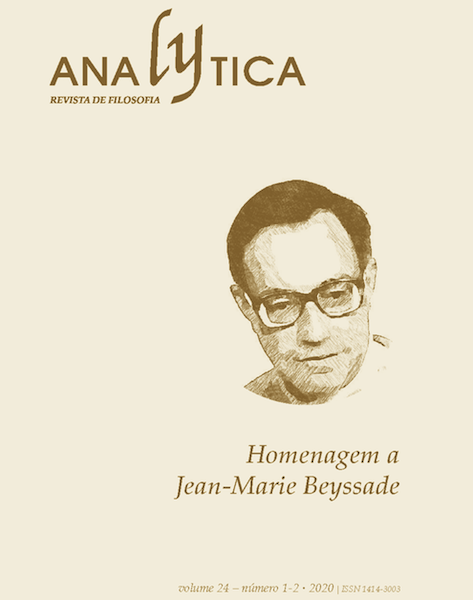
Inspirado na tese segundo a qual a revolução cartesiana inaugura de modo irreversível um tempo da ciência, Beyssade compara a formação do pensamento em duas histórias de vida paralelas: a de Rousseau, quando o escritor genebrino estabelece os princípios de sua filosofia, e a do próprio Beyssade, quando este revisa a interpretação da obra de Rousseau que aprendera com seu mestre Robert Derathé.Downloads
Não há dados estatísticos.
Referências
DESCARTES, R. Oeuvres de Descartes. Ed. Charles Adam & Paul Tannery. Paris: J. Vrin, 1996 (tomos III e VI).
______. Obras escolhidas. Trad. J. Guinsburg et al. São Paulo: Perspectiva, 2010.
ROUSSEAU, J.-J. OEuvres complètes. Ed. Marcel Raymond & Bernard Gagnebin. Paris: Gallimard, 1959(t. I), 1964 (t. III), 1969 (t. IV). Col. Bibliothèque de la Pléiade.
______. Émile e Sophie, ou Os solitários. Trad. Françoise Galler. São Paulo: Hedra, 2010.
Downloads
Publicado
09-09-2022
Como Citar
BEYSSADE, Jean-Marie. Escolha de princípios e irreversibilidade do tempo em J.-J. Rousseau. Analytica - Revista de Filosofia, [S. l.], v. 24, n. 1-2, p. 147, 2022. DOI: 10.35920/arf.v24i1-2.54453. Disponível em: https://revistas.ufrj.br/index.php/analytica/article/view/54453. Acesso em: 16 set. 2026.
Edição
Seção
Artigos
Licença
Os autores que publicam nesta revista concordam com os seguintes termos:
- Os autores mantêm os direitos autorais e concedem à revista o direito de primeira publicação, com o trabalho simultaneamente licenciado sob a Licença Creative Commons Atribuição-SemDerivações 4.0 Internacional (CC BY-ND 4.0), que permite a redistribuição, comercial ou não comercial, desde que a obra original não seja modificada e que seja atribuído o crédito ao autor.
- Os autores têm autorização para assumir contratos adicionais separadamente para distribuição não-exclusiva da versão do trabalho publicada nesta revista (ex.: publicar em repositório institucional ou como capítulo de livro), com reconhecimento de autoria e publicação inicial nesta revista.
- Os autores têm permissão e são estimulados a publicar e distribuir seu trabalho online (ex.: em repositórios institucionais ou na sua página pessoal) a qualquer ponto antes ou durante o processo editorial, já que isso pode gerar alterações produtivas, bem como aumentar o impacto e a citação do trabalho publicado (Veja O Efeito do Acesso Livre).