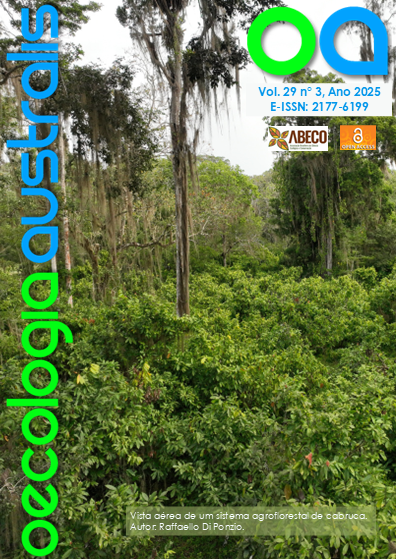
PATTERNS OF TAXONOMIC DIVERSITY OF POMPILIDAE AND MUTILLIDAE (HYMENOPTERA: POMPILOIDEA) IN AGRICULTURAL LANDSCAPES IN THE BRAZILIAN ATLANTIC FOREST OF SOUTHERN BAHIA
Taxonomic diversity of parasitoid wasps in agricultural landscapes
DOI:
https://doi.org/10.4257/oeco.2025.2903.06Abstract
The suppression of native forests for agricultural expansion is the primary driver of biodiversity loss in tropical regions. However, agroforests have been deemed biodiversity-friendly systems due to their ability to shelter forest species, including the shade-cocoa agroforests of southern Bahia (locally known as “cabrucas”). Nonetheless, most studies in cabrucas have focused on vertebrates, whereas research on insects (including wasps) is scarce, despite their significance for ecosystem functioning. Here, we investigated the effects of (i) environmental type (cabruca or native forest), (ii) landscape forest cover (from 8.5% to 82%), and (iii) regional deforestation context (i.e., high, intermediate and low levels of deforestation) on the richness and composition patterns of stinging ectoparasitoid wasp assemblages (Pompilidae and Mutillidae) in the agricultural landscapes of southern Bahia in the Brazilian Atlantic Forest. We carefully selected 30 landscapes varying in regional and landscape context and conducted wasp sampling within one cabruca and one Atlantic Forest remnant per landscape using Malaise flight interception traps. We thus performed Generalized Linear Mixed Models separately for each family to assess the influence of predictor variables on species richness. We further used the Sorensen dissimilarity index to investigate species composition dissimilarity among (i) environmental types and (ii) regional types, in addition to Permutational Multivariate Analysis of Variance, to examine the effects of landscape forest cover on species composition. In total, we collected 82 individuals belonging to 39 species considering all 60 sampling sites, resulting in reduced richness in both forest (mean ± SD = 1.10 (±1.31) and agricultural (1.23 ±1.31) environments. In contrast to our initial prediction, no variables affected patterns of species richness. Furthermore, we observed high dissimilarity in species composition between environments and regions, whereas species composition was unaffected by forest cover. Our results therefore suggest that cabrucas can act as supplementary habitats for parasitoid wasps but cannot replace native forests.
Downloads